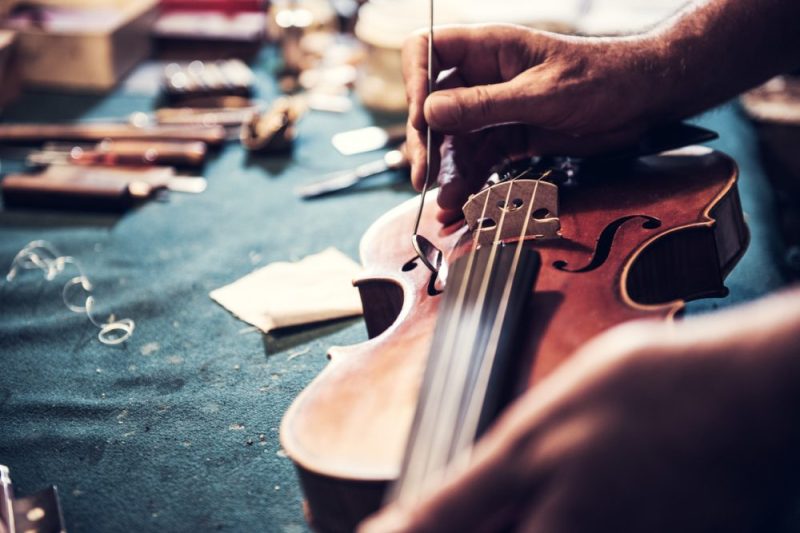
I had the pleasure of getting together with Mr. Jonathan Price, an established luthier based in Michigan. While he is primarily a violin maker, Mr. Price has also crafted multiple cellos, including the one that I currently use. With a strong local reputation for creating high-caliber instruments, I feel fortunate and thankful to have had this experience.
One of the first things we discussed was how Jon decided on the unique career of violin making. After being introduced to the violin as a child, he worked in a violin shop throughout high school. Under the guidance of the older violin maker Brian Bishop, Jon decided to pursue his career as a luthier.
If you’re a classical musician or have ever worked in the acoustic instrument industry, you’ve probably heard the common notion that older instruments are better than newer, more recently made ones. Jon dispels this as a myth, explaining, “This comes from hundreds and hundreds of years of marketing.” We discussed an article on an extensive blind experiment measuring professional preference for older and newer violins. In the study, Jon noted that most professionals didn’t know what they were playing half the time, demonstrating that there isn’t an impactful acoustical difference between old and newer instruments. He also pointed out, however, that one of the article’s authors, Joe Curtin, is also biased, as he himself is a violin maker who would benefit from the destigmatization of newer instruments.
We also had an interesting conversation about technology. Mr. Price views technology as a tool he can use to improve the speed and reduce the difficulty of making an instrument. He showed me his CNC (computer numerical control) machine, which he uses to create rough versions of certain violin parts. He demonstrated how the machine could copy one of his violin shapes and carve out a rough version of that design. He then refines the machine-shaped piece by hand with a knife. Mr. Price mentioned that there are CNC machines much more advanced than his own. With a high-end CNC machine costing upwards of a hundred thousand dollars, it’s entirely possible to machine carve something close to a finished instrument.
Overall, my meeting with Mr. Price was both enlightening and inspiring. His approach to combining traditional craftsmanship with modern technology showcases the evolving nature of violin making. For both musicians and makers, his insights offer a refreshing perspective on the creation and appreciation of fine instruments.
 Trev Talks
Leave a comment